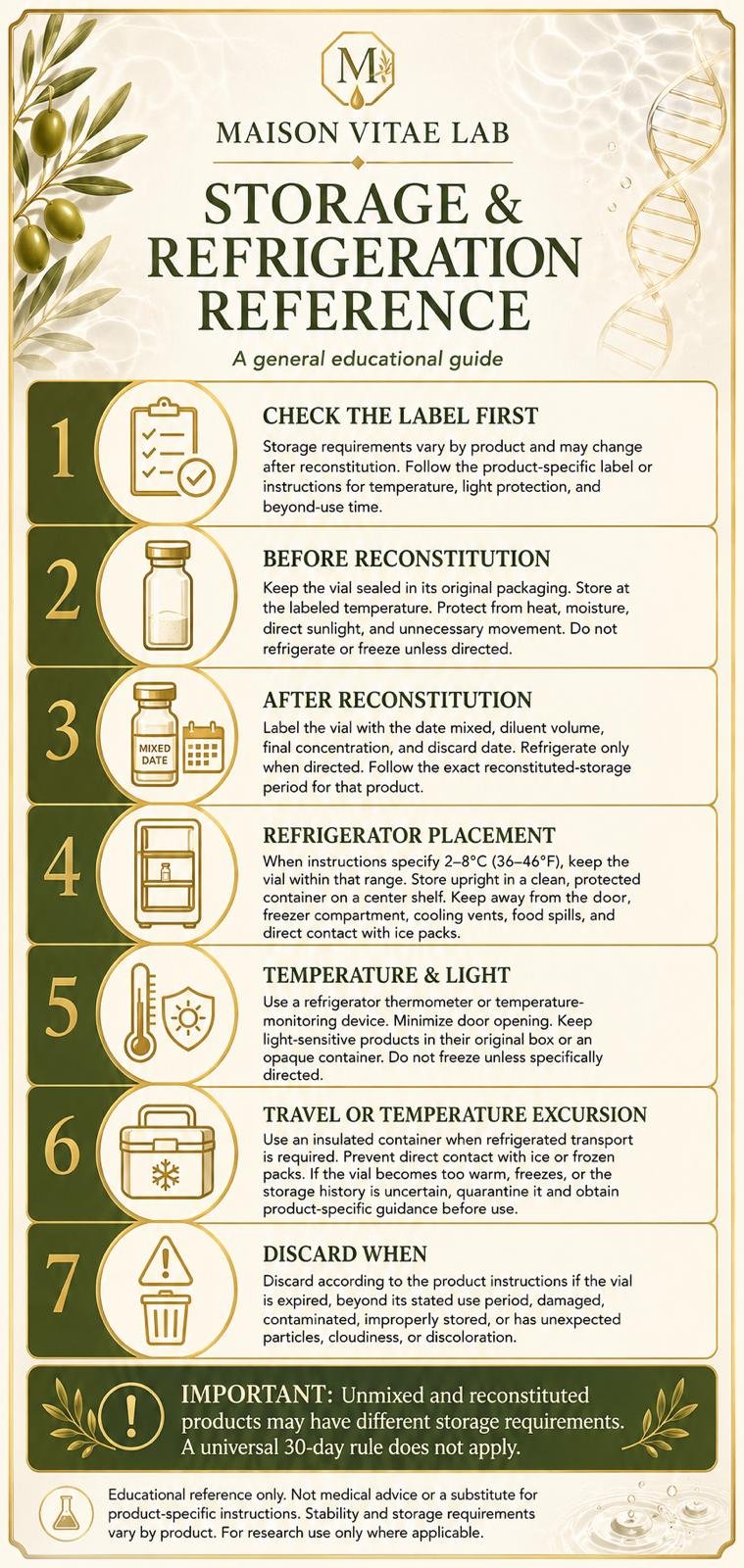
Storage & Refrigeration Guide
Proper storage helps protect product stability, quality, and integrity. Storage requirements can vary significantly between products and may change after reconstitution.
Always follow the storage temperature, light-protection instructions, expiration date, and beyond-use period provided for the specific product. Do not assume every product requires refrigeration or remains stable for the same amount of time.
1. Check the Label First
Before storing any product, confirm:
- The product name and strength
- Whether the vial is mixed or unmixed
- The required storage temperature
- Whether protection from light is required
- Whether freezing is permitted or prohibited
- The expiration or beyond-use date
- Any special handling instructions
When the label or product instructions differ from this general guide, always follow the product-specific directions.
2. Before Reconstitution
Unmixed or lyophilized products should remain sealed in their original vials and packaging until they are ready to be reconstituted.
Before reconstitution:
- Store the vial at the temperature stated in the product instructions.
- Keep the vial sealed and upright.
- Protect it from direct sunlight, excessive heat, and moisture.
- Avoid unnecessary shaking, dropping, or movement.
- Keep the vial in its original box or another protective container when light protection is required.
- Do not refrigerate or freeze the product unless specifically directed.
Refrigeration requirements for unmixed products can differ from the requirements that apply after reconstitution.
3. After Reconstitution
Once a product has been reconstituted, its storage requirements and usable period may change.
Immediately label the vial with:
- Product name and strength
- Type of diluent used
- Amount of diluent added
- Final concentration
- Date and time reconstituted
- Required discard or beyond-use date
Refrigerate the reconstituted vial only when directed by the product instructions. Always follow the exact temperature range and beyond-use period specified for that product.
A universal 30-day refrigeration rule does not apply to all reconstituted products.
4. Refrigeration Temperature
When a product’s instructions specify refrigerated storage at 2–8°C or 36–46°F, maintain the vial within that temperature range.
For safer refrigerator storage:
- Use a refrigerator thermometer or temperature-monitoring device.
- Store the vial upright in a clean, protected container.
- Place it on a center shelf where the temperature is more stable.
- Keep it away from the refrigerator door.
- Keep it away from the freezer compartment, cooling vents, and cold walls.
- Do not allow the vial to touch ice or frozen packs.
- Keep it protected from food, moisture, and spills.
- Minimize unnecessary refrigerator-door opening.
Do not rely only on the refrigerator’s control setting. An internal thermometer provides a more accurate indication of the actual storage temperature.
5. Protect From Freezing
Do not freeze a product unless its instructions specifically require or permit frozen storage.
Accidental freezing may damage certain products even if the vial later thaws and appears normal.
To reduce the risk of freezing:
- Do not place vials directly beneath cooling vents.
- Do not store vials against the back wall of the refrigerator.
- Do not place vials inside or directly beside the freezer compartment.
- Do not allow direct contact with ice or frozen gel packs.
- Do not refreeze a thawed product unless specifically instructed.
If a product may have frozen, separate it from usable inventory and obtain product-specific guidance before use.
6. Protect From Light
Some products are sensitive to light.
When light protection is required:
- Keep the vial inside its original box.
- Use an opaque or light-protective storage container.
- Keep it away from windows and direct sunlight.
- Limit the amount of time the vial remains under bright lighting.
Do not remove the vial from its protective packaging more often than necessary.
7. Refrigerated Travel and Transportation
When refrigerated transportation is required, use an insulated medication travel case or another suitable temperature-controlled container.
During transportation:
- Keep the vial upright and securely protected.
- Separate the vial from ice or frozen packs with a barrier.
- Do not allow the vial to freeze.
- Keep it away from direct sunlight and excessive heat.
- Limit the amount of time outside the required temperature range.
- Use a temperature-monitoring device when appropriate.
- Return the vial to proper storage promptly after travel.
Do not leave temperature-sensitive products inside a parked vehicle, checked luggage, or another uncontrolled environment.
8. Power Outages and Temperature Excursions
If the refrigerator loses power or the vial is exposed to an unknown temperature:
- Keep the refrigerator door closed as much as possible.
- Record the current temperature if it can be checked safely.
- Document how long the product may have been outside its required range.
- Do not automatically return the product to regular inventory.
- Keep the vial separated and clearly marked.
- Obtain product-specific stability guidance before use.
Do not assume that a product is safe simply because it looks normal. Appearance alone cannot confirm stability or potency.
9. Inspect Before Use
Before accessing a stored vial, inspect it carefully under adequate lighting.
Do not use the product if:
- The vial is cracked, leaking, or damaged.
- The seal or stopper has been compromised.
- The product is expired.
- It is beyond its stated use period.
- Its storage history is unknown.
- It was improperly refrigerated or frozen.
- Sterility is uncertain.
- There are unexpected particles, cloudiness, discoloration, or other changes in appearance.
Some products naturally differ in color or clarity. Always compare the vial’s appearance with its product-specific instructions.
10. When to Discard
Discard the product according to its instructions when:
- The expiration or beyond-use date has passed.
- It has been stored outside the required temperature range.
- It has accidentally frozen when freezing is prohibited.
- The vial or seal is damaged.
- Contamination is suspected.
- The product has an unexpected change in appearance.
- The storage history cannot be confirmed.
- The manufacturer, supplier, pharmacist, or licensed professional directs you to discard it.
Follow applicable local requirements for disposing of the vial and its contents.
Important Reminder
Never apply one storage temperature or shelf-life rule to every product.
Disclaimer
This information is provided as a general educational reference only. It is not medical advice and does not replace product-specific storage instructions, manufacturer labeling, stability information, or guidance from a licensed healthcare professional.